
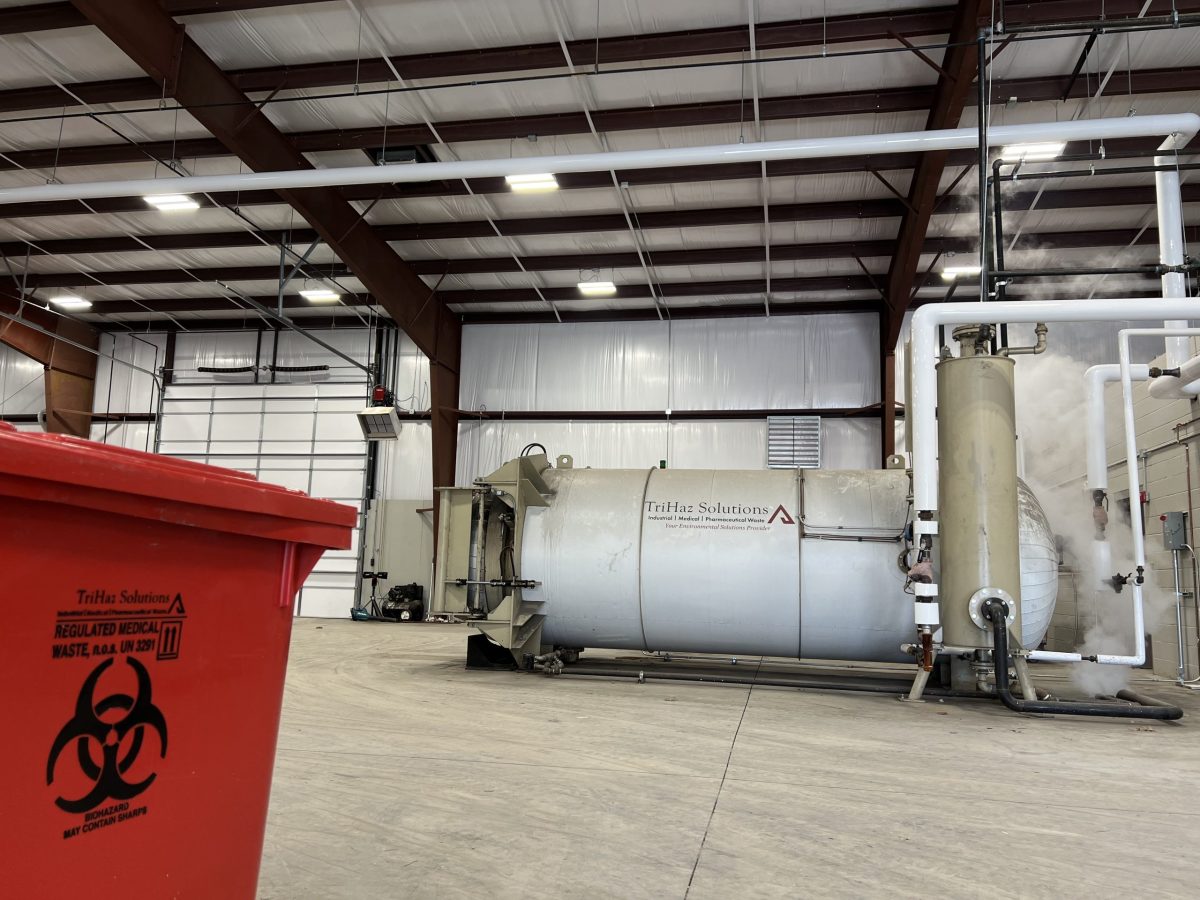
TriHaz Solutions President Kevin Webber recently talked with Birmingham Medical News to discuss Alabama’s most significant medical waste regulatory overhaul in more than a decade. [Read the full article here.]
The Birmingham Medical News article covers the headline changes well – documentation requirements, the new transport window, and what small practices need to know about storage conditions. But the interview prep behind that conversation surfaced a lot of detail that couldn’t all fit into the article. We want to share that here, because the more Alabama healthcare providers understand about these updates, the better positioned they are to stay compliant, avoid penalties, and protect their patients and staff.
First, Some Context: Why These Changes Matter
Alabama’s medical waste regulations under Alabama Department of Environmental Management (ADEM) Division 335-17 hadn’t been substantively updated since 2012. A lot changed in the healthcare landscape in the intervening 13 years – how care is delivered, who delivers it, where it happens, and what kinds of waste are generated as a result.
In 2024, ADEM convened a working group of industry stakeholders, hospital associations, and commercial operators to propose updates. TriHaz Solutions was the only commercial medical waste treatment facility involved in that process – giving us a front-row seat to how the changes were shaped and why.
The result was a two-phase update: Phase One took effect February 14, 2025, covering generator requirements, packaging standards, and documentation. Phase Two took effect August 14, 2025, covering transportation, treatment facility standards, and storage conditions for all generator sizes.
If your practice hasn’t reviewed its compliance posture since before February 2025, there is a real chance you are already operating under outdated procedures.
Who Needs to Pay Attention
The article focuses primarily on physician practices and clinics – the core readership of Birmingham Medical News. But ADEM’s definition of a medical waste generator is broader than many people realize. Any facility or individual that produces regulated medical waste (RMW) falls under these rules.
That includes:
- Hospitals, health systems, and surgery centers
- Physician offices, clinics, and specialty practices
- Dental offices
- Physical therapy practices
- Dialysis centers and infusion centers
- Laboratories and research facilities
- Aesthetic and med spa clinics, including facilities offering injections, laser treatments, or cosmetic procedures
- Tattoo shops because needles and blood-contaminated materials qualify as regulated medical waste
- Nursing homes and long-term care facilities
- Home health agencies
- Veterinary clinics
- Funeral homes
- Emergency medical services
One important nuance: each individual business entity in a shared building is considered a separate generator – even if multiple physicians share one address. A multi-physician practice suite doesn’t consolidate into a single generator status.
What “Regulated Medical Waste” Actually Means
Not all waste generated in a healthcare setting is regulated under ADEM’s Division 335-17. The rules apply specifically to regulated medical waste (RMW) – materials that pose infectious or hazardous risk. This includes:
- Blood and blood products (liquid blood, blood-saturated materials capable of dripping)
- Pathological waste (human tissues, organs, body parts from surgery or autopsy)
- Sharps (needles, scalpels, IV tubing with attached needles, broken contaminated glass)
- Microbiological waste (laboratory cultures, stocks of infectious agents)
- Surgical waste (saturated gowns, dressings, sponges, gloves)
General packaging, paper, food waste, and non-contaminated materials are not regulated medical waste and go into the standard solid waste stream. Understanding this distinction matters; it defines exactly what your compliance obligations apply to.
The Three Types of Facilities the Regulations Cover
The 2025 updates apply across three distinct categories, and the obligations differ for each. The Birmingham Medical News article focuses primarily on generators, but it’s worth understanding all three – especially since the documentation requirements apply across the board.
Generators are any facility or person who produces regulated medical waste (RMW). Most healthcare practices fall into this category. The 2025 updates tightened documentation expectations, clarified storage requirements, and introduced new registration requirements for generators.
Transporters are companies permitted to pick up and move medical waste off-site. They must hold a valid ADEM Medical Waste Transporter Permit and comply with U.S. DOT requirements. Under the 2025 updates, transporters must now maintain written Medical Waste Management Plans, documented training records, and spill response documentation; and must notify ADEM in writing any time the 14-day transport window will be exceeded.
Treatment facilities are permitted sites where medical waste is rendered safe through an approved process – autoclave (steam sterilization), incineration, or pyrolysis – before final disposal. The 2025 updates introduced a more formal permitting process for treatment facilities, including public comment periods and public notices, similar to how solid waste landfills are permitted in Alabama.
TriHaz Solutions supports these functions from our Huntsville, Alabama headquarters – we are a permitted transporter and treatment facility. That means RMW we collect stays within our chain of custody from pickup through final disposal, without being handed off to a third party for treatment.
The Small Generator Storage Change — A New Obligation Many Don’t Know About
This is one of the most significant changes for small and independent practices, and some businesses that may not realize they are now regulated by these new updates.
Before: Generators producing under 220 pounds of regulated medical waste per month were completely exempt from storage condition requirements. No refrigeration standard, no non-putrescibility requirement – nothing.
After: All generators – regardless of volume – must now maintain waste in a non-putrescent state during accumulation (Rule 335-17-2-.01(3)). Small generators have a generous six-month accumulation window, but the storage condition requirement applies universally.
What Does “Non-Putrescent State” Mean in Practice?
ADEM does not define the term in Division 335-17 – it carries its plain meaning: waste must not be allowed to rot or decompose during storage. The regulation sets an outcome standard, not a specific method.
For most small practices generating primarily dry waste (sharps, non-saturated packaging) proper sealed rigid containers are generally sufficient to meet the standard.
For practices with wet waste (blood-saturated materials, pathological waste, or surgical byproducts) decomposition happens faster, and sealed containers alone may not be adequate over weeks or months. Temperature control becomes the practical solution.
The six-month accumulation window is a ceiling, not a target. For wet waste generators, the practical answer is ensuring pickups are frequent enough that decomposition is never a realistic risk.
The Documentation Changes in More Detail
The Birmingham Medical News article covers the training records and certificates of destruction requirements. Here is the fuller picture of what the documentation overhaul actually requires – and who it applies to.
Training Records
Who it applies to: Generators (effective February 14, 2025), transporters and treatment facilities (effective August 14, 2025).
Before: Training of employees was required since 2012, but the language was vague with no specified retention period. Verbal training and informal reminders were common practice and difficult to challenge during inspections.
After: Written training records must be maintained for current staff until the facility closes – not just while the employee is there. Records for former employees must be kept for a minimum of three years after departure. The training must be documented, dated, and available to ADEM upon request.
Certificates of Destruction
Who it applies to: Treatment facilities (obligation to provide); generators (obligation to retain).
Before: A single annual written certification that waste had been properly treated was sufficient for inspection purposes.
After: Certificates of destruction are now required for every disposal event, not just annually. Generators should be retaining these as part of their audit documentation. If your vendor isn’t providing per-disposal certificates, that is a problem worth addressing now.
Written Medical Waste Management Plan
Who it applies to: All facility types.
Before: A written plan was required since 2012, but content requirements were broadly defined, leaving significant room for interpretation.
After: The plan must now explicitly address training records, unloading and handling procedures, emergency preparedness, recordkeeping procedures, and closure notification. Plans that were adequate in 2024 may no longer satisfy the 2025 standard.
TriHaz works directly with clients to create and update Medical Waste Management Plans that meet ADEM’s current requirements – including all content areas now explicitly mandated under the 2025 updates. TriHaz also offers online compliance training with printed records available to meet the required training documentation.
The Transport Window; A Loosening That Is Now Enforceable
The article correctly explains that the old four-hour transport rule was replaced with a 14-day window. This is technically a loosening of the rule, but the enforceability is what’s new.
The old four-hour rule was unworkable and largely ignored in practice. The 14-day window is realistic, which means ADEM now has a benchmark it can and will hold transporters to. Any exception beyond 14 days requires documented written notification to ADEM explaining why.
For generators, this means: verify your pickup schedule, don’t assume it. Practices whose vendors come every three to four weeks may already be outside the new standard. Your vendor’s schedule is your compliance exposure.
Generator Registration – Check Your Status
The article notes that registration has always been a requirement, now more clearly defined. What it doesn’t cover is that ADEM added an entirely new Chapter 8 to Division 335-17 establishing formal registration and permitting requirements for generators, transporters, storage facilities, and treatment facilities. This is a new compliance layer, and the formal effective date for registration requirements has not yet been published.
The practical advice is simple: confirm your ADEM registration status directly with ADEM rather than assuming your prior registration carries over. The contact for the Medical Waste Program is ADEM’s Land Division.
The Penalty Picture
The article cites Alabama’s penalty structure – $25,000 per day per violation for a first offense, doubling to $50,000 per day for repeat violations – before any federal EPA exposure. The 2024 case in Minnesota, where a regional hospital was fined $100,000 for improper infectious waste disposal and required to overhaul its waste management plan, is the kind of real-world outcome that illustrates what enforcement actually looks like.
The penalties matter, but they’re not the primary reason to get this right. Improper medical waste handling creates genuine public health risk: infection spread, needlestick injuries, and community contamination. Compliance is a patient and employee safety issue, not a paperwork exercise.
What’s Coming Next: Federal Requirements Are Layering On
While the 2025 ADEM updates are the most immediate compliance concern, federal changes are building on top of state rules. The EPA is advancing a transition from paper-based hazardous waste manifests to mandatory electronic reporting. Not all medical waste generators have hazardous waste, but for those that do, a shift is expected to reach most jurisdictions by late 2026.
Because Alabama operates under ADEM’s delegated authority from the EPA, federal mandates ultimately flow downstream to Alabama facilities. Practices still catching up to the 2025 ADEM changes will face a steeper climb when federal electronic reporting requirements arrive on top.
ADEM also signaled during the 2025 rulemaking cycle that several topics raised in public comments were not addressed and may be revisited. More changes are likely coming. Staying ahead of them is easier than catching up after the fact.
Sources for this article: Birmingham Medical News article: What Alabama’s New ADEM Regulations Mean for Your Practice,
ADEM Division 335-17